


Fall 2026
Identifying nitrosamine impurities, a practice that began with a focus on human pharmaceuticals, is expanding to other personal care and consumer products, and manufacturers would be wise to consider using a combination of approaches when assessing susceptibilities.
The inadvertent formation of nitrosamines has become an important product safety and regulatory concern across a range of healthcare and consumer products. Nitrosamines, also known as N-nitroso compounds, comprise a class of chemicals that include substances known to be potent carcinogens in experimental animals. These compounds can form when nitrosatable precursors, such as amines, react with nitrosating agents during product manufacturing or storage. Notably, the discovery of N-nitrosodimethylamine (NDMA) in blood pressure and heartburn medications triggered regulatory activity related to the control of nitrosamine impurities from health agencies worldwide. While much of this activity has been focused on human pharmaceuticals, over-the-counter drugs, such as sunscreens and personal care products, may be susceptible to nitrosamine formation.
Nitrosamines, also known as N-nitroso compounds, comprise a class of chemicals that include substances known to be potent carcinogens in experimental animals.”
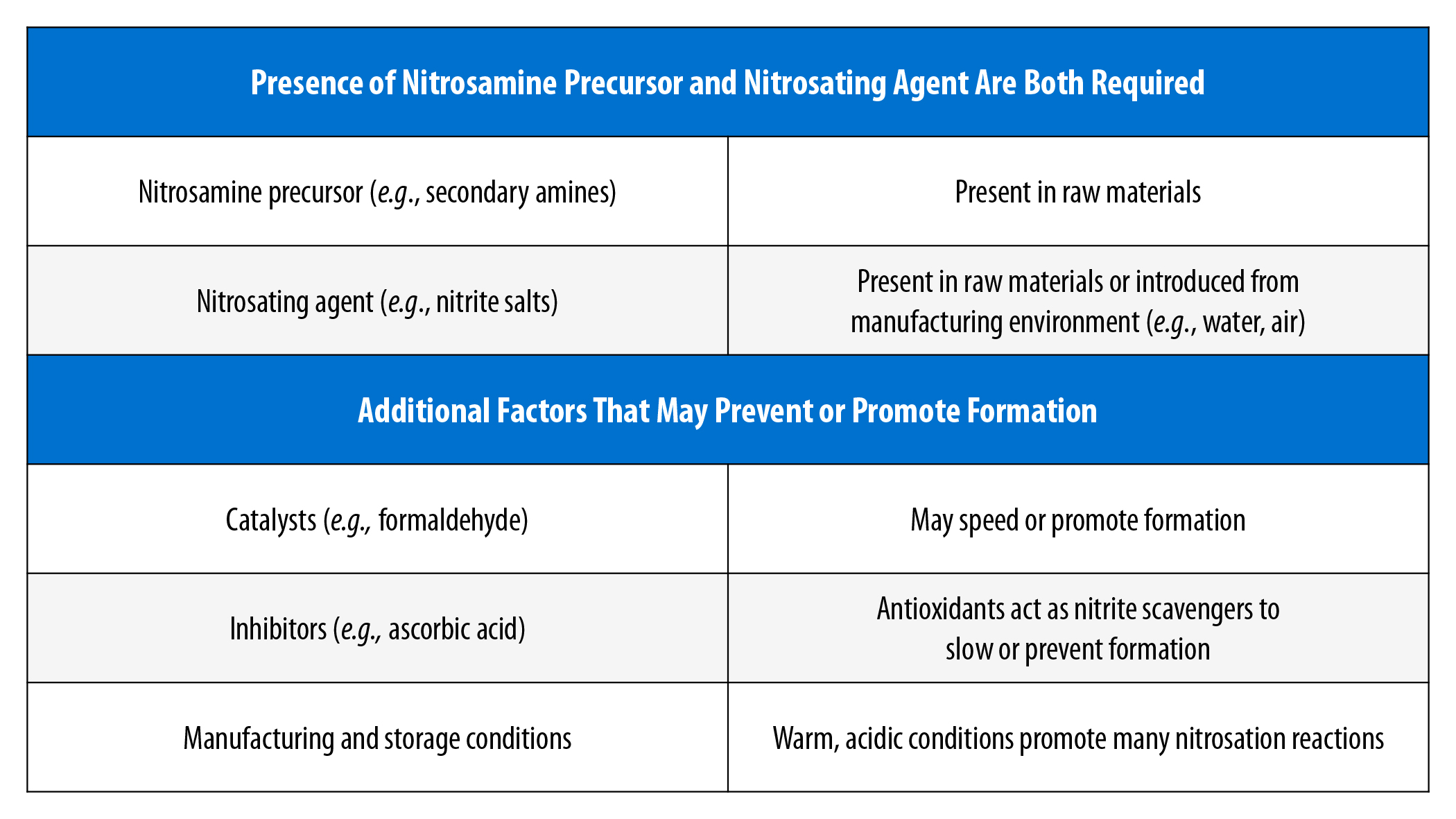
In its guidance for industry, the United States Food and Drug Administration (US FDA) Center for Drug Evaluation and Research (2024) recommends manufacturers perform a risk assessment to determine whether a hypothetical risk of nitrosamine formation exists for their drug products or active pharmaceutical ingredients (APIs). This assessment should include an evaluation of potential sources of nitrosamine precursors and nitrosating agents (e.g., nitrite salts, alkyl nitrites, or other compounds that produce a nitrosonium ion), including raw materials and sources introduced potentially during the manufacturing process. Amines and amides are two broad chemical classes with nitrosatable groups that may be present as ingredients or impurities in raw materials. Within these groups, the propensity for nitrosamine formation varies widely based on chemical structure. For example, aliphatic secondary amines, such as diethanolamine, are expected to readily undergo nitrosation in the presence of nitrite. In contrast, amides have a lower reactivity with common nitrosating agents as a result of the electron-withdrawing properties of the carbonyl group. Additionally, existing nitrosamines may be present as impurities in certain raw materials. As such, a review of product formulations for ingredients and impurities belonging to these classes can be performed to identify potential risks and prioritize products.
Even in the absence of favorable reaction conditions, risks cannot always be excluded due to the highly potent nature of some of these substances and the potential for precursors to exist at relatively high concentrations.”
In addition to controlling for the presence of precursor chemicals and sources of nitrosating agents, nitrite-scavenging inhibitors (e.g., ascorbic acid) and pH adjusters may be used as part of a strategy to mitigate nitrosamine formation. In contrast, warm, acidic conditions will promote many nitrosating reactions and the presence of certain compounds, such as quaternary ammonium salts, may catalyze the formation of nitrosamines. As a result, manufacturing and storage conditions should be considered when assessing the potential for nitrosamine formation (see Figure). Even in the absence of favorable reaction conditions, risks cannot always be excluded due to the highly potent nature of some of these substances and the potential for precursors to exist at relatively high concentrations. In other words, nitrosation reactions that occur slowly or to a limited extent may still generate nitrosamine levels of potential toxicological significance.
In cases where the potential for nitrosamine formation is expected to be high, the structure of the nitrosamine can be predicted and evaluated for safety (i.e., carcinogenicity) based on conservative assumptions. This process involves an assessment of systemic exposure, which is then compared to an acceptable intake (AI) value to determine if risks are acceptable or further safety data are needed. One option for developing an appropriate AI is the US FDA’s Carcinogenic Potency Categorization Approach – a structure activity relationship (SAR)-based framework that assigns chemicals to one of five categories, each with a conservative default AI. This approach is often used as a first tier in the risk assessment process, though other approaches, such as read-across and the generation of safety data (e.g., Ames test), may be employed.
The identification and control of nitrosamines in product categories other than pharmaceuticals is an emerging area of interest that requires unique considerations. For example, sunscreens and personal care products often involve higher application rates compared to the therapeutic doses used for many drug products, so conservative screening-level safety evaluations may not resolve some safety questions. In addition, the identity, function, and composition of inactive ingredients in these products is distinct from those used in pharmaceuticals. Strategies involving targeted testing of formulated products for specific nitrosamines, while useful, may not be exhaustive due to the limited number of nitrosamines for which targeted methods have been developed. Furthermore, development of these targeted methods is time and resource intensive. Analytical testing for apparent total nitrosamine content (ATNC) may be used as an alternative strategy to screen raw materials or products. This method measures the N-nitroso functional group rather than targeting a specific nitrosamine that is potentially present in a test sample.
As interest in nitrosamine impurities expands beyond pharmaceuticals, manufacturers of sunscreens, personal care products, and other formulated products may benefit from proactive risk management strategies that combine formulation review, analytical testing, and appropriate mitigation measures. Such approaches can help identify potential concerns early, support product safety, and prepare manufacturers for evolving regulatory expectations.
The authors can be reached at Charlotte.Marsh@gradientcorp.com and Pranav.Mashankar@gradientcorp.com.
US Food and Drug Administration (US FDA), Center for Drug Evaluation and Research (CDER), Pharmaceutical Quality/Manufacturing Standards (CGMP). 2024. “Control of Nitrosamine Impurities in Human Drugs: Guidance for Industry (Revision 2).” 46p., September. Accessed on April 22, 2025, at https://www.fda.gov/media/141720/download.