


Winter 2026
The newly released ISO 10993-1:2025 standard allows alternative methods to animal testing for the assessment of the “material-mediated pyrogenicity” (MMP) effect, with substance class categorization playing a key role in method determination.
The newly released International Organization for Standardization (ISO) 10993-1:2025 standard employs the latest scientific evidence to refine the “material-mediated pyrogenicity” (MMP) effect. Once a requirement for nearly all medical devices, the MMP effect was addressed exclusively, until recently, through the in vivo rabbit pyrogen test (RPT). ISO 10993-1:2025, however, states that: “In many cases, it can be sufficient to present a rationale” in lieu of RPT data. What are these cases? To address that question, we must first understand the concept of a “material-mediated pyrogen.”
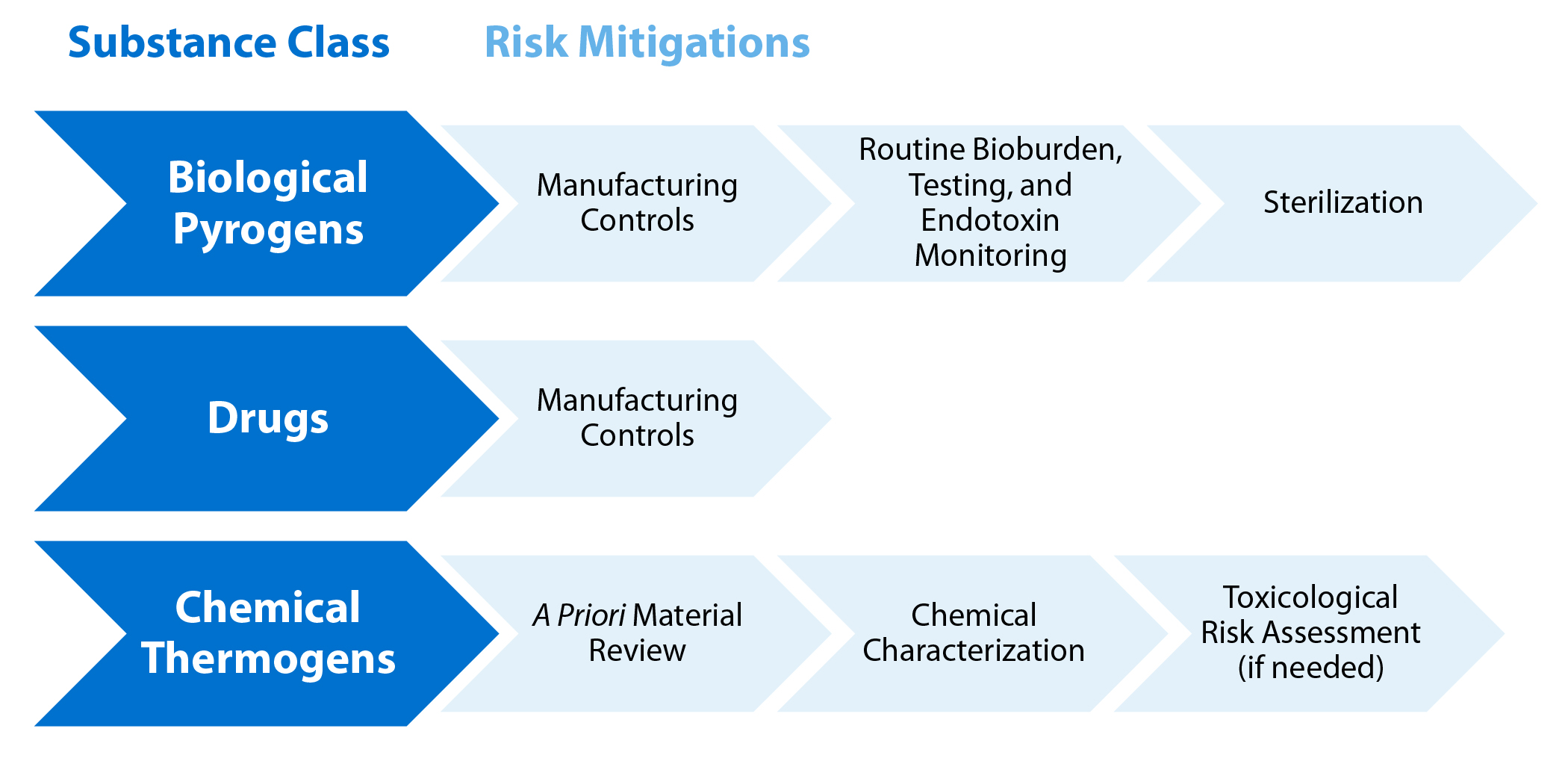
Borton and Coleman (2025) conducted a literature review of substances listed in Annex G of ISO 10993-11:2017 that are allegedly MMPs in medical devices. The “MMP” term has been used historically to describe any substance with the ability to produce a febrile/fever response, regardless of its origin or mechanism of action. Borton and Coleman (2025) found the term to be scientifically inaccurate, since increases in body temperature can be due to several mechanisms of action. Therefore, fit-for-purpose evaluation is required based on a substance’s class. To this end, Borton and Coleman (2025) identified three classes of substances that can elevate body temperature: 1) biological pyrogens; 2) drugs; and 3) chemical thermogens. These categorizations can help medical device manufacturers determine appropriate evaluation strategies (see Figure). Furthermore, by classifying a hyperthermic substance, and conducting the appropriate evaluations described in this article, even novel materials need not require RPT testing.
The “MMP” term has been used historically to describe any substance with the ability to produce a febrile/fever response, regardless of its origin or mechanism of action.”
Biological Pyrogens
Biological pyrogens are biological-based substances that upregulate cytokines to elicit a fever. These substances can be exogenous and endogenous, such as endogenous signaling molecules, human mimics like synthetic double-stranded RNA molecules, endotoxin and non-endotoxin, yeast, viruses, and fungi. Biological pyrogens are present overwhelmingly due to manufacturing environment contamination. Consequently, the key risk mitigation strategy for biological pyrogens includes appropriate manufacturing controls, routine bioburden testing, endotoxin monitoring, and adequate sterilization. In accordance with the ISO 10993-1:2025 risk-based framework, these controls effectively mitigate the pyrogenic hazard potential of biological pyrogens; thus, a justification for pyrogen risk is not warranted. Realistically, having a description of key manufacturing controls and sterilization processes in place to reduce biological pyrogens should provide evidence of product safety for regulators. Finally, if a manufacturer identifies gaps in their manufacturing controls, the in vitro monocyte activation test (MAT) detects a broad array of endotoxin and non-endotoxin biological pyrogens and is well suited for the detection of human-relevant pyrogens that elicit a fever through the cytokine pathway.
Drugs
Drugs, either controlled or illicit, produce elevated body temperature through a wide range of mechanisms. Within medical devices, drugs are strictly regulated by device design and manufacturing process controls. Like biological pyrogens, drugs should not be considered a hazard within an ISO 10993-1:2025 risk-management framework.
Chemical Thermogens
Chemical thermogens elicit a hyperthermic response through uncoupling of oxidative phosphorylation (UOP), where the phosphorylation of adenosine diphosphate to adenosine triphosphate is disrupted leading to an increased metabolic rate and heat production (Kessler et al., 1976). Borton and Coleman (2025) identified 47 UOP substances and noted that 91 percent of UOPs are not soluble in saline, the sole extraction solvent used by the RPT. Therefore, the RPT is unable to detect the vast majority of UOPs.
Borton and Coleman (2025) published a list of established UOPs (with Chemical Abstracts Service [CAS] numbers) in Supplement 1 of their article. Instead of the RPT, this list is a tool to empower manufacturers, contract laboratories, and consultants to screen for UOP hazards by reviewing the:
If UOPs are detected, a toxicological risk assessment, in accordance with ISO 10993-17:2023, should be conducted to ensure UOP exposure is below the threshold for thermogenic effects. Borton and Coleman (2025) determined that UOPs in medical devices are extremely rare, except C12-C18 long chain fatty acids (LCFAs), which are common in medical device materials. Under specific biological conditions, LCFAs can act as uncouplers (Demine et al., 2019); however, they are common dietary ingredients. Furthermore, the quantities of LCFAs required to elicit an adverse hyperthermic response vastly exceed the quantities that cause more severe health effects. Therefore, a toxicological risk assessment of LCFAs is not required to demonstrate safety from thermogenic effects.
Recent evidence indicates the RPT cannot detect chemical thermogens; hence, it is not suitable for routine monitoring of febrile effects from medical devices. While ISO 10993-1:2025 states a justification is warranted for most MMP evaluations, we believe a justification is sufficient for all situations because “MMPs” are now classified and characterized. Hazard potential from biological pyrogens should be evaluated though a review of the manufacturing controls, routine monitoring, and sterilization, while hazard potential from chemical thermogens should be evaluated through materials characterization.
Kelly Coleman is a Senior Distinguished Toxicologist at Medtronic with 30 years of experience providing preclinical product development support across all Medtronic businesses. He is also an adjunct professor at the School of Public Heath at the University of Minnesota. Dr. Coleman is a member of the College of Fellows of the American Institute for Medical and Biological Engineering (AIMBE). He can be reached at Kelly.P.Coleman@medtronic.com.
Lindsey Borton can be reached at Lindsey.Borton@gradientcorp.com.
Borton, L; Coleman, K. 2025. “Material-mediated pyrogens in medical devices: Myth or reality?” ALTEX doi: 10.14573/altex.2504231.
Demine, S; Renard, P; Arnould, T. 2019. “Mitochondrial uncoupling: A key controller of biological processes in physiology and diseases.” Cells 8(8):795. doi: 10.3390/cells8080795.
Kessler, RJ; Tyson, CA; Green, DE. 1976. “Mechanism of uncoupling in mitochondria: Uncouplers as ionophores for cycling cations and protons.” Proc. Natl. Acad. Sci. USA 73(9):3141-3145. doi: 10.1073/pnas.73.9.3141.