


Winter 2026
Recent updates to ISO 10993-1 promote a more risk-based, life cycle-centric approach to determining the safety of medical devices.
The International Organization for Standardization (ISO) 10993-1 is the international standard guiding the evaluation of medical device biocompatibility, helping manufacturers identify and mitigate biological risks based on device materials, type, and intended use. The newly published 2025 edition of ISO 10993-1 introduces a significant shift toward a risk-based, life cycle-centric approach, aligned with ISO 14971 and recent regulations, such as the European Union Medical Device Regulation (EU MDR) (ISO, 2025). This updated edition of ISO 10993-1 requires biological safety assessment throughout the entire device life cycle – from design, material selection, manufacturing, transport, and storage, to clinical use, servicing, and final disposal.
This life cycle perspective covers the “lifetime” of the device, which is defined as the active use period and can range from minutes for a disposable device to years for implants. This edition of the ISO standard mandates continuous risk evaluation whenever materials degrade, cleaning cycles are added, or the device environment changes and new risks emerge, including degradation products or altered risk profiles due to reprocessing or other factors. Further, risk assessments must be updated routinely with every change in materials, manufacturing, or use.
Compliance with the standard demands proactive, evidence-driven updates rather than one-time checklist certifications, promoting deeper global harmonization and enhanced device safety.”
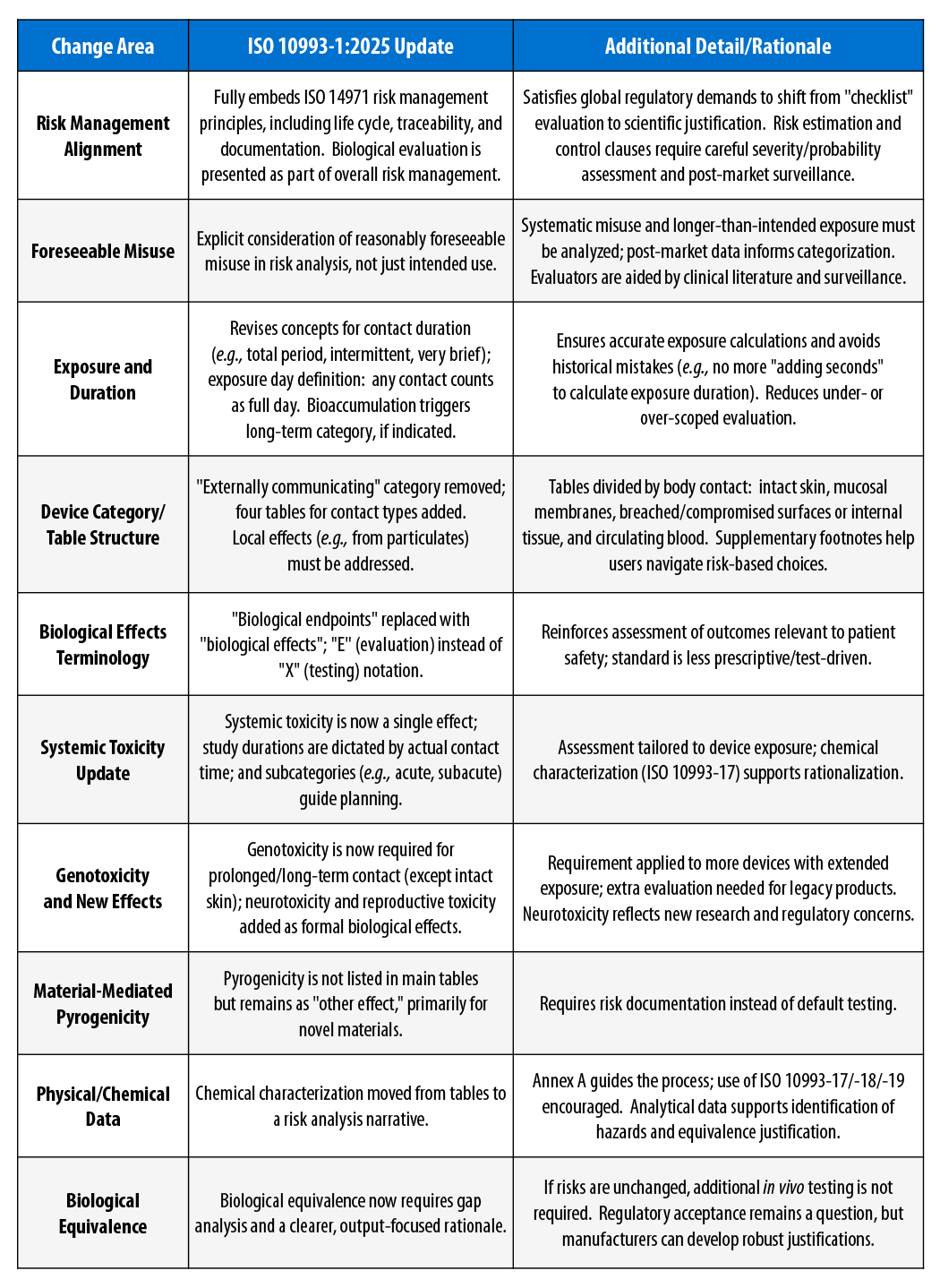
Key provisions of the ISO 10993-1:2025 update include:
Additional key changes include assessment of reasonably foreseeable misuse scenarios, refined patient contact and exposure duration categories, new criteria for material-mediated pyrogenicity testing (see the Borton and Coleman article in this issue of Trends), and clearer guidance for establishing biological equivalence. The updated framework integrates risk estimation as a core element of device risk management, setting higher standards for evaluating systemic toxicity, local effects after tissue contact, end-of-life biological effects, and material characterization – resulting in more comprehensive and clinically relevant biological safety documentation. The Table below summarizes several important updates and their implications.
While the updated standard does not require retesting all legacy devices, it raises the bar for comprehensive, multidisciplinary documentation and continuous assessment. Moreover, this significant revision transforms biocompatibility evaluation into a dynamic, life cycle-oriented process that is essential for ensuring patient safety and regulatory compliance. As such, compliance with the standard demands proactive, evidence-driven updates rather than one-time checklist certifications, promoting deeper global harmonization and enhanced device safety.
The authors can be reached at Daysi.Diaz-Diestra@gradientcorp.com and Lindsey.Borton@gradientcorp.com.
International Organization for Standardization (ISO). 2025. “ISO 10993-1:2025: Biological evaluation of medical devices – Part 1: Requirements and general principles for the evaluation of biological safety within a risk management process (Sixth Edition).” ISO 10993-1: 2025 (en). 52p.