


Fall 2025
Testing to evaluate chemical migration from packaging into food is an important step in evaluating product safety, but gaps in current testing protocols will need to be addressed to ensure regulations are truly met.
In recent years, there has been increased concern regarding chemicals in food packaging. Per- and polyfluoroalkyl substances (PFAS) and other chemicals may be intentionally present in food contact materials, such as plastic additives, mold release agents, and grease-resistant coatings of paper products, or unintentionally present (e.g., contaminants in recycled materials). Chemicals in food contact materials have the potential to migrate into foods and act as a source of oral exposure to people. Given this concern, the Food Packaging Forum, a scientific advocacy organization, has summarized the available literature on the subject in their “Database on Migrating and Extractable Food Contact Chemicals (FCCmigex)” (Food Packaging Forum, 2025). Through this database, the organization has estimated that almost 4,000 food contact chemicals are known to migrate from food contact materials at some level; however, relatively little is known about the significance of these findings for human health (Geueke et al., 2024). To address this gap, the availability of chemical migration information is growing due to regulatory limits and testing requirements enacted in many jurisdictions, as shown in the examples below:
The availability of chemical migration information is growing due to regulatory limits and testing requirements enacted in many jurisdictions.”
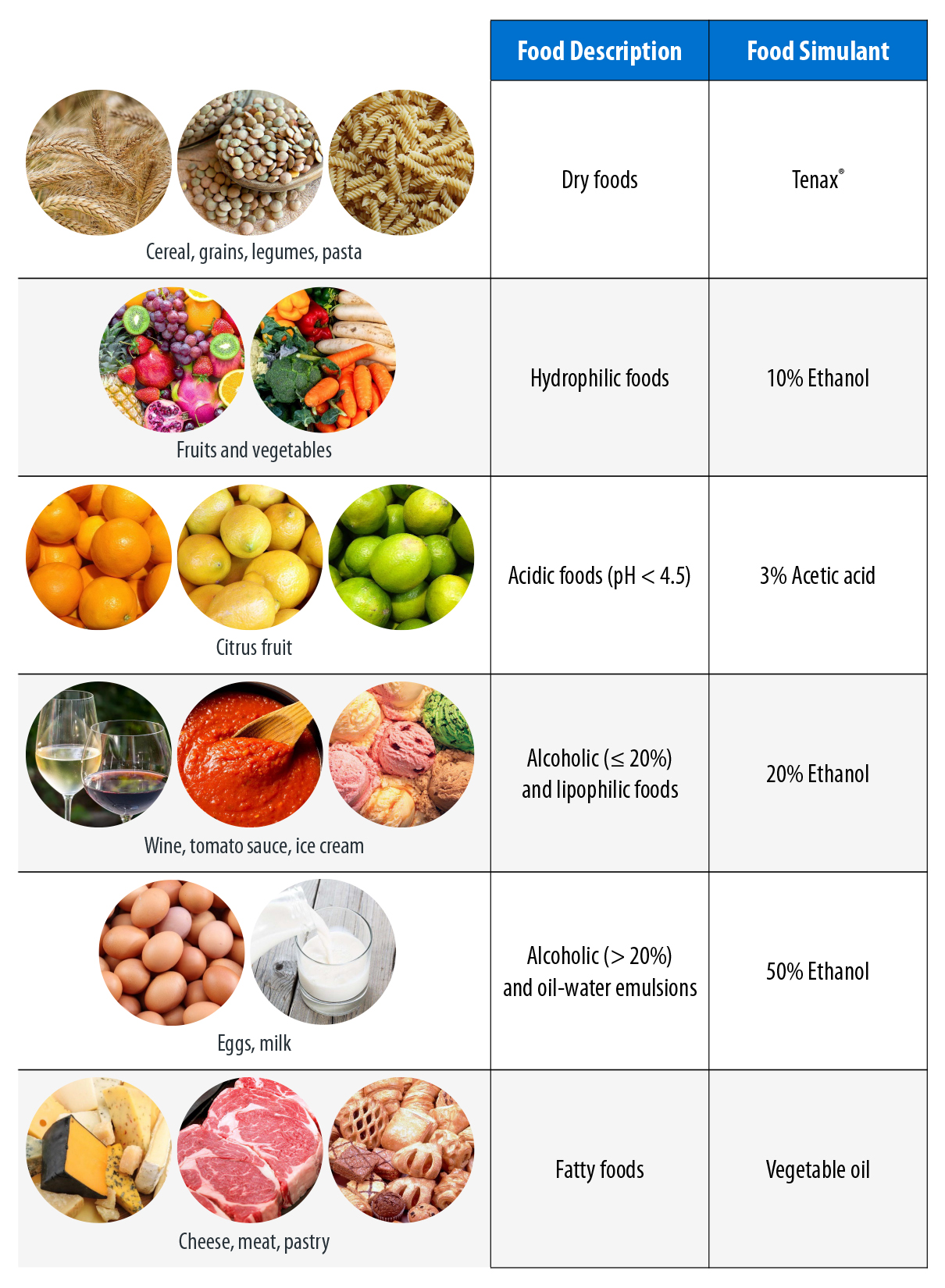
One of the biggest concerns with food contact migration testing is to determine the most appropriate testing conditions. Migration data should be obtained under worst-case intended-use conditions (e.g., time, temperature) utilizing appropriate food simulating solvents. Using actual food items can often introduce analytical uncertainty due to heterogeneity or analytical interferences; therefore, foods are replaced with food simulants (see Table). Extraction with the food simulant is then followed by appropriate analytical methods for the food contact chemicals of concern.
In addition to food migration testing for known substances and additives, the EU requires testing for non-intentionally added substances (NIAS) in plastics. NIAS include impurities, such as those from the recycling process, reaction products and intermediates, and irradiation products. Initial NIAS screening can be performed via thermal desorption mass spectrometry (MS), but, generally, exhaustive solvent extraction is used to allow a full assessment and quantitation of any potential contaminants. Solvent extraction generates higher concentrations, which facilitates identification and quantification during analysis by gas chromatography-MS (GC-MS) (e.g., volatiles), liquid chromatography-MS (LC-MS) (e.g., non-volatiles), and inductively coupled plasma-MS (ICP-MS) (e.g., inorganic). Care should be taken, however, that the solvent extraction is not overly strong, which may result in the degradation of the material. NIAS analysis is followed by risk assessment to determine if potential exposures are below specific migration limits, if available, or tolerable daily intakes.
Migration data should be obtained under worst-case intended-use conditions (e.g., time, temperature) utilizing appropriate food simulating solvents.”
Current food contact testing protocols for both intentionally added substances or NIAS are designed to evaluate chemicals, such as PFAS, that may migrate into food by diffusion or advection. However, emerging concerns for potential particle contamination, such as microplastics that are typically less than 5 millimeters (mm) in diameter, may not be identified by these standard methods. Given the presence of microplastics in the environment, it can be difficult to determine the source of microplastics in food. Test methods – with experimental designs that can show increases in microplastic concentration via time, temperature, distance, or physical manipulation of the materials – are needed to establish a causal relationship between food packaging and microplastic contamination of food. Currently, the lack of standardized tests for microplastic migration from food contact materials is a gap that will need to be addressed before these plastic particles can be regulated effectively.
Migration testing is only the first step in evaluating the safety of food packaging. Even if a chemical may leach out of a food contact material, additional research is needed to understand whether the food packaging represents a significant source of exposure compared to other sources, and whether the chemical or chemical mixture may present a potential health risk to people.
The author can be reached at Carrie.Tuit@gradientcorp.com.
China National Health Commission (NHC). 2025. “GB 9685-2016 – Amendment No. 1 – Standard for Uses of Additives in Food Contact Materials and Articles.” National Health and Family Planning Commission of the People’s Republic of China. GB9685-2025 (2025XG1 Amendment No. 1). March 16, 265p.
Deutsches Institut fur Normung e.V. (DIN) [German Institute for Standardization]. 2002. “Materials and Articles in Contact with Foodstuffs – Plastics – Part 1: Guide to the Selection of Conditions and Test Methods for Overall Migration (EN 1186-1).” DIN EN 1186-1:2002. July, 48p.
Deutsches Institut fur Normung e.V. (DIN) [German Institute for Standardization]. 2004 “Materials and articles in contact with foodstuffs – Plastics substances subject to limitation – Part 1: Guide to test methods for the specific migration of substances from plastics to foods and food simulants and the determination of substances in plastics and the selection of conditions of exposure to food simulants. DIN EN 13130-1:2004. August, 63p.
European Commission (EC). 2011. “Commission Regulation (EU) No 10/2011 of 14 January 2011 on Plastic Materials and Articles Intended to Come into Contact with Food (Text with EEA relevance).” Off. J. Eur. Union L 12:1-89. Commission Regulation (EU) No 10/2011, January 14. Accessed on September 11, 2025, at https://eur-lex.europa.eu/legal-content/EN/TXT/PDF/?uri=CELEX:32011R0010.
Food Packaging Forum. 2025. “Database on Migrating and Extractable Food Contact Chemicals (FCCmigex) (Version 3.0).” Accessed on September 11, 2025, at https://foodpackagingforum.org/resources/databases/fccmigex#dashboard.
Geueke, B; Parkinson, LV; Groh, KJ; Kassotis, CD; Maffini, MV; Martin, OV; Zimmermann, L; Scheringer, M; Muncke, J. 2024. “Evidence for widespread human exposure to food contact chemicals.” J. Expo. Sci. Environ. Epidemiol. doi: 10.1038/s41370-024-00718-2.
US Food and Drug Administration (US FDA). 2025. “Subchapter B – Food for human consumption.” 21 CFR 170-199. 610p. Accessed on September 11, 2025, at https://www.govinfo.gov/content/pkg/CFR-2025-title21-vol3/pdf/CFR-2025-title21-vol3-chapI.pdf.