


Fall 2025
Efforts by the United States Food and Drug Administration to make major changes to food regulations are gaining traction and paving the way for reform.
Both the United States Environmental Protection Agency (US EPA) and the US Food and Drug Administration (US FDA) regulate chemicals; however, over the years, their approaches have had some apparent differences. The US EPA has taken a consistent direct and active role in evaluating and regulating chemicals. This is evident in the evaluation frameworks established for pesticides and herbicides, the development of risk-based environmental health standards, and the chemical-specific hazard and risk assessments conducted under the Integrated Risk Information System (IRIS) program. In addition, US EPA’s Toxic Substances Control Act (TSCA) program has been amended recently to allow for the intensive assessment of priority chemicals in commerce.
In comparison, US FDA’s role regarding non-pharmaceuticals has been arguably more reactive, particularly in regulating food additives. Although a pre-market approval process exists for direct food additives introduced after 1958, older ingredients were allowed to remain on the market without a prospective review. Moreover, most new ingredients since 1958 have been evaluated under the Generally Recognized As Safe (GRAS) system, where manufacturers, or outside expert panels organized by manufacturers, make safety determinations. Some of these GRAS assessments can be submitted to US FDA for limited review as GRAS notifications. Consequently, due to the GRAS system and the grandfathering of older ingredients, only a small fraction of additives has undergone a comprehensive safety evaluation by US FDA.
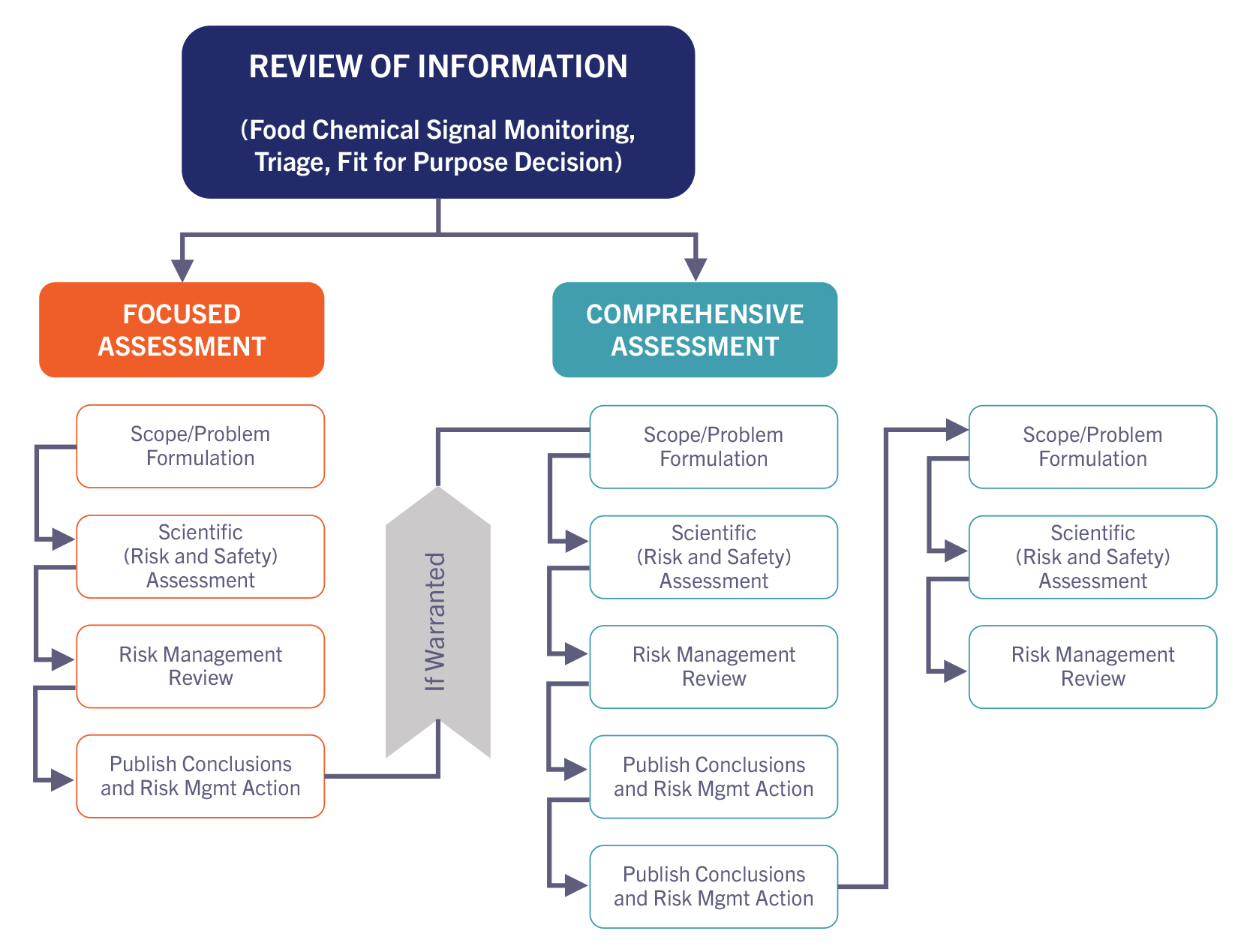
Acknowledging some deficiencies in this traditional system, US FDA started ramping up activity related to food additive assessment in 2024, coinciding with the end of the Biden administration. Consequently, in August 2024, US FDA published a proposed new post-market assessment process for chemicals in food (US FDA, 2024). This proposed process includes focused assessments, which are relatively limited in scope, and comprehensive assessments, which are complex and resource intensive (see US FDA Process Flow Chart). Synthetic dyes have been the initial target for this enhanced review process; thus, in the wake of this initiative, on January 15, 2025, US FDA announced that it would revoke the authorization for the use of FD&C Red No. (US FDA, 2025a).
Although overall there has been a push to reduce regulatory hurdles at US FDA, food safety regulation appears to be on a different track. Following previous initiatives, enhanced oversight is a key aspect of the “Making America Healthy Again (MAHA)” movement. For example, US FDA has introduced proactive, science-based measures for food safety, moving away from case-by-case post-market reviews. Moreover, as a testament to a renewed call to action, on April 22, 2025, US FDA announced the revocation of two synthetic dyes (i.e., Citrus Red No. 2 and Orange B) and plans to phase out more (US FDA, 2025b). This action coincided with the approval of four new natural replacement dyes.
US FDA is in the process of revising a modernized prioritization scheme to identify existing food ingredients and additives that should undergo US FDA safety evaluations.”
Efforts to scrutinize other existing additives are a key initiative of US FDA. The agency is in the process of revising a modernized prioritization scheme to identify existing food ingredients and additives that should undergo US FDA safety evaluations. Accompanying this effort will be a list of chemicals currently under review or expected to come under review. Toward this end, a preliminary list has already been published and includes both additive and food contaminants (US FDA, 2025c).
US FDA’s emphasis on a more robust evaluation process for post-market additives is accompanied by a desire to reduce reliance on the GRAS program, which previously allowed for manufacturers to develop their own safety assessments. While the GRAS program has been beneficial for ingredient innovation, critics have been concerned about a lack of transparency, conflicts of interest, and inadequate data to support safety (Food Safety Institute, 2024). On March 10, 2025, US FDA issued a press release indicating that the acting US FDA commissioner plans to explore potential rulemaking to revise the GRAS Final Rule and related guidance to eliminate the self-affirmed GRAS program.
The changes proposed by US FDA are ambitious, with some actions necessitating new legislation. Although legislative gridlock is all too common, food safety issues might be a rare opportunity for bipartisan cooperation. The calls for reform from US FDA are being echoed by Democratic lawmakers. In fact, on July 17, 2025, two Democratic senators introduced the “Ensuring Safe and Toxic-Free Foods Act of 2025” (US Congress, 119th, 1st Session, 2025). This legislation calls directly for a more proactive review of food additives and reforms the GRAS program. It also includes demands for increased transparency regarding the data and basis for regulatory determinations, as well as more comprehensive toxicological evaluations.
One additional important initiative to note is US FDA’s intention to define ultra-processed foods (UPFs). While several agencies outside the US have established definitions of UPFs, US FDA’s approach could have significant consequences because it may lead to direct regulatory actions, such as banning UPFs in school food programs. UPF issues were a major topic of the “MAHA report” released in May 2025, which focused on identifying the key factors contributing to chronic diseases in children (Executive Office of the President of the United States, 2025).
With the right political headwinds behind it, the upcoming changes to food regulations in the US have the potential to be significant. This transformation will require sound science that carefully balances safety, innovation, rigor, and efficiency. Most importantly, it will remain to be seen if US FDA’s appetite for change in food choices will be embraced by the American public.
The author can be reached at Ari.Lewis@gradientcorp.com.
Executive Office of the President of the United States, Make America Healthy Again (MAHA) Commission. 2025. “The MAHA Report: Make Our Children Healthy Again Assessment.” May 22, 73p. Accessed on July 28, 2025, at https://www.whitehouse.gov/wp-content/uploads/2025/05/MAHA-Report-The-White-House.pdf.
Food Safety Institute. 2024. “GRAS status: Ensuring the safety of food additives.” January 14. Accessed on July 28, 2025, at https://foodsafety.institute/food-toxicology-public-health/gras-status-food-additive-safety/.
US Congress, 119th, 1st Session. 2025. “A bill to amend the Federal Food, Drug, and Cosmetic Act to impose requirements for substances generally recognized as safe, to require the Commissioner of Food and Drugs to reassess the safety of chemicals added to food, and for other purposes [Ensuring Safe and Toxic-Free Foods Act of 2025] (Discussion draft).” KEN25423 XW2. Accessed on July 28, 2025, at https://www.booker.senate.gov/imo/media/doc/ensuring_safe_and_toxic-free_foods_act.pdf.
US Food and Drug Administration (US FDA). 2024. “Discussion Paper: Development of an Enhanced Systematic Process for the FDA’s Post-Market Assessment of Chemicals in Food.” August, 8p.
US Food and Drug Administration (US FDA). 2025c. “List of Select Chemicals in the Food Supply Under FDA Review.” Accessed at https://www.fda.gov/food/food-chemical-safety/list-select-chemicals-food-supply-under-fda-review.
US Food and Drug Administration (US FDA), Human Foods Program. 2025a. “FDA to revoke authorization for the use of Red No. 3 in food and ingested drugs.” January 15. Accessed on July 28, 2025, at https://www.fda.gov/food/hfp-constituent-updates/fda-revoke-authorization-use-red-no-3-food-and-ingested-drugs.
US Food and Drug Administration (US FDA), Office of the Commissioner. 2025b. “HHS, FDA to phase out petroleum-based synthetic dyes in nation’s food supply.” April 22. Accessed on July 28, 2025, at https://www.fda.gov/news-events/press-announcements/hhs-fda-phase-out-petroleum-based-synthetic-dyes-nations-food-supply.